Property & CasualtyMarket Update
Q1 2026
Commercial insurance leaders are navigating a market shaped by bigger jury awards, higher repair and medical costs, and tighter underwriting. Rates continue to trend upward across several key lines, but the differentiator now is how effectively an organization understands, manages, and communicates its overall risk.
Some parts of the market are starting to soften, especially for well-run accounts. That creates opportunities to improve pricing, add capacity, or adjust coverage if renewals are planned early and the story behind the risk is clear.
Property is one of the clearest bright spots right now. Rates are easing, and capacity is returning, which can create savings, especially for larger and more complex programs. At the same time, insurers are closely watching profitability; accounts still need strong engineering, clean data, and a clear view of catastrophe exposure.
Competition is increasing as established carriers expand and new capacity enters the market. That is good news for buyers, but it also means underwriters will pick their spots and push for details on protection, maintenance, valuations, and business continuity.
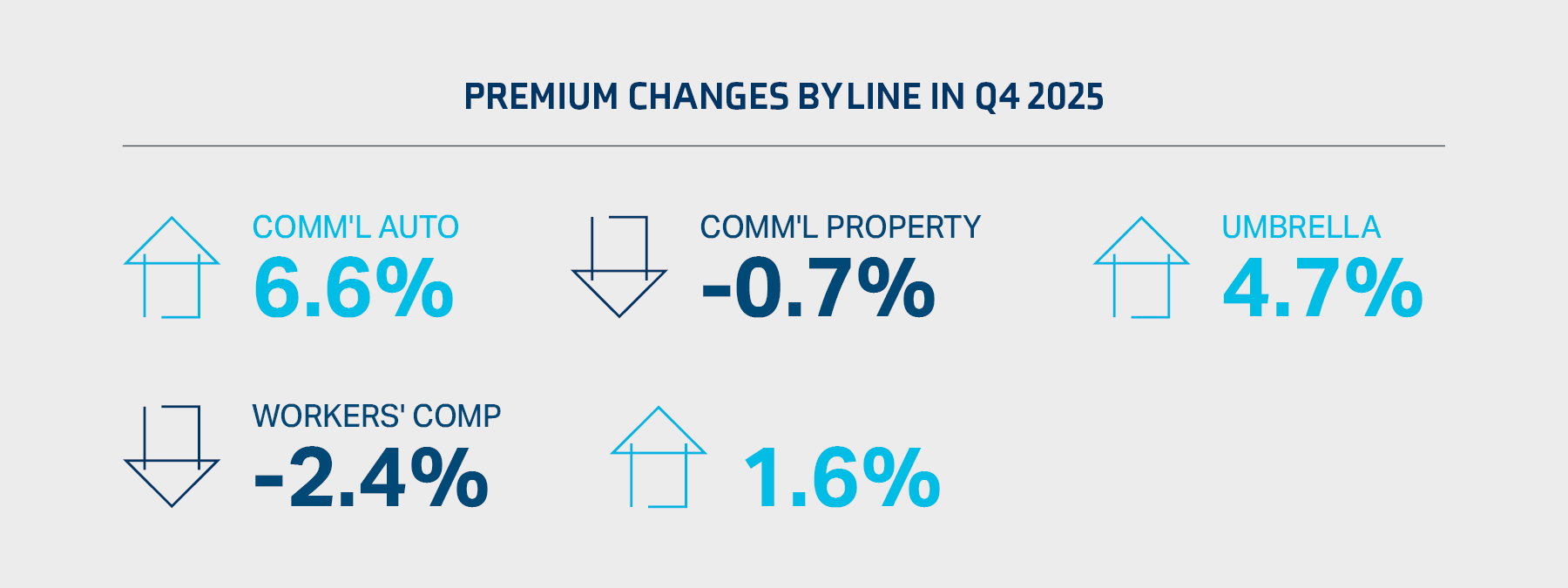
Industry data shows property rates have been trending down since Q3 2024. In Q4 2025, rates fell about 8%, reflecting stronger competition and added capacity, supported in part by lower reinsurance costs.2
In the field, the most aggressive pricing is on larger, complex property programs. Shared and layered placements are frequently delivering double-digit rate decreases, which is helping property-heavy buyers. Deductibles, especially wind and hail, continue to move down in many placements, and some package carriers are showing greater flexibility on tougher property risks. London remains an important source of capacity, but U.S. property markets are often leading on price right now.
Casualty remains the most challenging part of the insurance portfolio. To stay sustainable beyond 2026, insurers are pushing for better loss models, greater transparency, and a legal environment.
Regional Movement
Claims outcomes continue to be driven by one simple story: fewer claims are being filed, but the claims that do hit are costing more. The 2025 AIS “State of the Line” provides a clear snapshot of what is shaping loss costs and pricing decisions going into 2026.4
Severity Is Rising Faster than Pricing
In 2024, both indemnity and medical severity increased about 6%, outpacing wage growth (4.5%) and the workers’ compensation weighted medical price index (2.8%); higher utilization also drove costs.
A California verdict shows how fast an employment dispute can turn into a headline loss. In Williams, et al. v. Sysco Riverside, Inc., Sysco drivers and yard personnel said they reported safety and food-handling concerns, such as pressure to exceed speed limits on company property, loading perishables at unsafe temperatures, and skipping safety checks, and then faced a hostile work environment that pushed them out or led to termination for pretextual reasons. A Los Angeles jury awarded $52 million total ($31 million compensatory and $21 million punitive), reinforcing how social inflation and jury sentiment can create outsized outcomes.5
For employers, the message is practical: document safety decisions, respond quickly to concerns, train managers on the risk of retaliation, and consider whether arbitration agreements align with the organization’s broader employee-relations strategy.
Stephen DeMatteo | Chief Operating Officer, Northeast Region
Drew Hannan | Vice President, Commercial Lines Team Lead
Angela Thompson | Marketing Strategist, Market Intelligence & Insights
Brian Spinner | Marketing Specialist, Market Intelligence & Insights