Energy Market Update
Q4 2026
Energy buyers head into year-end renewals with more negotiating power than they’ve had in years. Across property, environmental, and marine lines, capacity is plentiful, catastrophic losses have stayed quiet, and carriers are competing hard for well-engineered, well-run accounts.
Casualty is the exception. For fleet-heavy E&P operators and oilfield service contractors, auto liability and umbrella remain the most constrained lines as claim severity and jury awards climb, and West Texas is still one of the hardest places in the country to place a fleet. Workers’ compensation remains favorable, though the same severity pressures are starting to show in this line.
At the same time, conflict in the Persian Gulf has pushed U.S. producers to drill and ship more. That means more contractors on location, more trucks on the road, and more product in tanks and terminals, just as underwriters sharpen their questions on contractor management, fleet controls, and legacy pollution.
This soft market is an opportunity to strengthen coverage, not just to cut premium. Fixing terms, limits, and coverage gaps now can put companies in a stronger position when conditions turn.
This soft market is an opportunity to strengthen
coverage, not just to cut premium.
Property remains a buyer’s market. Placements are routinely drawing far more capacity than they need, and that oversubscription is pushing rates down at renewal. Energy insurers absorbed heavy refining and downstream losses in 2025, yet rates kept falling into 2026 because capacity remains abundant.1 A quiet Atlantic hurricane season has only added to the downward pressure
Lower property rates make accurate BI values increasingly important at renewal.
The exception is business interruption (BI). Underwriters are asking for current BI worksheets and pushing back on values or indemnity periods that don’t hold up, especially where equipment is idle or operations have changed. Clients should consider whether conducting a business interruption study can help better quantify and understand their BI exposures so that BI values and indemnity periods can be updated before their program goes to market, not after an underwriter questions them.
Renewal pricing is still rising across the core casualty lines, though increases have eased during the year. In August, general liability renewals were up an average of 4% and commercial auto were up an average of 3.5%, both smaller increases than earlier in the year.2
General liability renewals were up an average of 4% in August.
Commercial auto remains the hardest line to place for clients, and West Texas is the most challenging region. Some carriers won’t write for vehicles garaged in the Permian Basin. Others will only quote fleets fitted with auto controls, including cameras, GPS tracking, and continuous motor vehicle record (MVR) monitoring already in place. Large auto verdicts in Texas and Louisiana keep carriers cautious across the Gulf Coast, and auto controls are now the first thing casualty underwriters ask about.
Even with ample excess capacity overall, the lead umbrella layer over the primary auto and general liability has become harder to fill for fleet-heavy energy accounts. Carriers are deploying smaller limits, pushing retentions higher, and tightening how auto claims aggregate under the policy. Claim costs continue to outpace premiums, and the 2026 outlook for both commercial auto and general liability is negative.3 Lloyd’s has warned that casualty rates look inadequate given how long these claims take to settle,4 and some London lead markets are now offering 18-month terms so buyers can hedge against a market turn.
Workers’ compensation remains casualty’s bright spot, with renewal pricing still slightly down.5 While the coverage pricing is down, claim costs are rising for many of the same reasons as auto.
When underwriters want a risk, they
compete for it.
LONDON AND DOMESTIC MARKETS
London remains the swing factor in placements. The push into middle‑market accounts described in Q1 is holding, and new capacity continues to enter the energy space. When underwriters want a risk, they compete for it.
For loss‑sensitive casualty programs, a London tower is now a real alternative to domestic capacity, though London typically won’t attach to lower limits.
There is a growing view that the market will shift in the next 12 to 18 months. Buyers with London placements should plan submissions early and expect more questions.
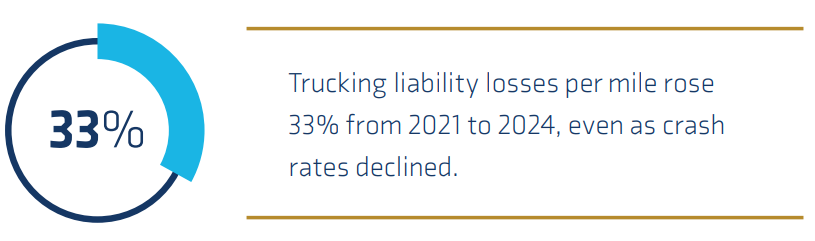
Auto and workers’ compensation are moving in opposite directions on price, but the claim picture underneath is the same: fewer claims, higher cost per claim. In trucking, liability losses per mile rose 33% from 2021 to 2024 while crash rates fell.6 Litigation and larger settlements, not more accidents, are driving that gap, and fleets running heavy equipment on rural West Texas roads feel it more than most.
Workers’ compensation shows the same pattern, but at a slower pace. Lost-time claims fell 2% in 2025, but average cost per claim rose 4% for both medical and indemnity.7 About half the rise in medical costs comes from injured workers receiving more care, led by more inpatient stays,8 even as workers’ compensation medical price inflation cooled below 2% this spring.9 Severity also climbs with pay: the highest-paid injured workers run about 50% higher medical costs per claim than the lowest-paid.10 The trend has been building for several years and shows no sign of reversing.
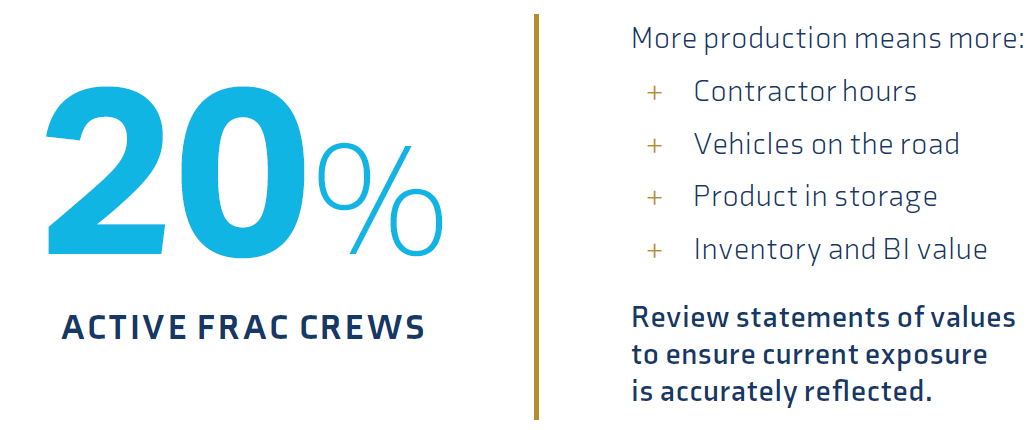
The Persian Gulf conflict gave U.S. producers a reason to drill. By May, the oil rig count was at its highest since late 2025, active frac crews were up 20% since January, and Permian output hit a record.11 For insurance programs, more activity means more contractor hours, more trucks on the road, and more product in tanks and terminals, all of which feed auto, workers’ compensation, and pollution exposure. Higher oil prices also raise inventory and BI values, so a statement of values that has not been updated since last renewal may understate what’s at risk.
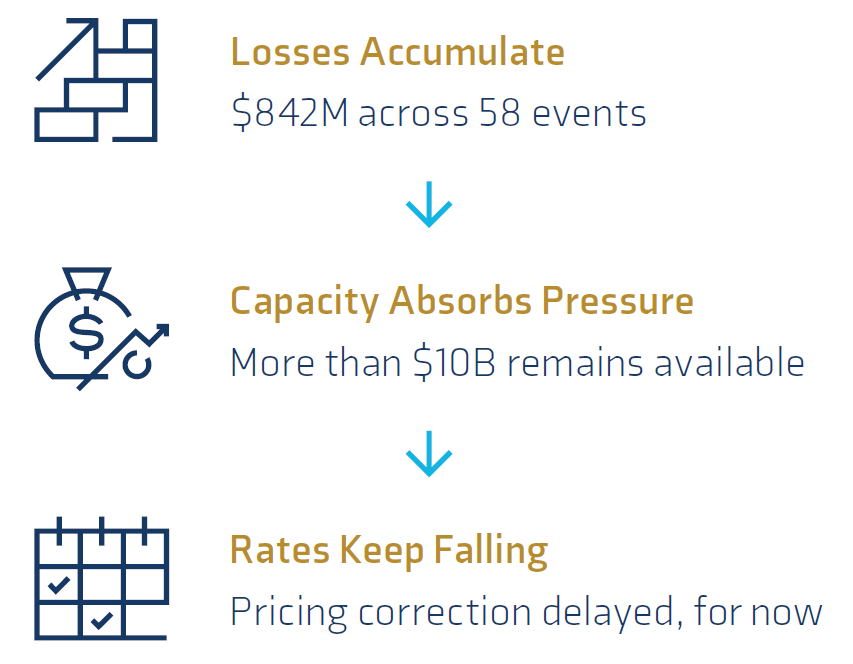
The Q1 Energy Market Update reported that notable 2025 losses could push control of well (CoW) pricing toward a correction in late 2026 or into 2027.12 So far, capacity is winning. Upstream energy insurers absorbed about $842 million in losses across 58 events in 2025, yet upstream capacity still tops $10 billion and rates have kept falling.13 That won’t hold forever if losses keep coming, and the claims section below shows they have. Operators should expect more underwriting questions on well control plans, casing integrity, and P&A procedures, and should have clear answers ready.
A significant group of carriers now require one or more fleet controls: telematics, dash cameras, or continuous MVR monitoring. Contractors that resisted them are now adopting them, and the results back it up. In one pilot, dash cameras cut risky driving events by 40% in two months. The payoff shows first in fewer losses and lower retained costs, and over time in a loss history that earns better terms at renewal.
For loss-heavy casualty accounts, the answer is increasingly structure, not price. Recent renewal data show companies facing significant renewal concerns lowered total costs by moving excess tower to London and using a surety bond in place of part of their collateral. Buffer layers, multi-year programs, and punitive damages wraps are becoming standard tools, and clients with difficult loss histories should explore them well before renewal.
Knowing what peers buy is a useful data point, but it shouldn’t set limits on its own. Peer benchmarks should be paired with public loss data, such as pipeline releases and regulatory fines, and with engineering models of plausible worst-case events. One recent analysis modeled a vapor cloud explosion at a proposed gas processing train and estimated a loss of about $80 million in property damage and business interruption, assuming an 18-month rebuild against a 12-month policy indemnity period. Gaps like that are common. A formal BI study and scenario modeling make limit decisions deliberate and give underwriters more confidence in the exposure they’re pricing.
For loss-heavy casualty accounts, the answer is increasingly structure, not price.
Environmental markets remain competitive. Loss-free pollution legal liability (PLL) renewals are running flat to up 5% on average, and capacity is available for data center projects, though underwriters are digging into site history, fuel storage, backup generation, and water use. Appetite is tighter for legacy contamination, produced water management, and waste disposal operations.
One major energy carrier’s standalone gradual pollution product has performed poorly, especially in New Mexico, and the carrier is raising retentions across its book from $100,000 to $250,000 over land and from $250,000 to $500,000 over water.
Cyber governance is also becoming a differentiator for terminals, offshore operators, and logistics providers after federal agencies warned in April that Iran-linked hackers were targeting industrial controls at U.S. energy sites.14 On the tax side, insurance for 45Z clean fuel credits has opened up, and buyers are increasingly insuring the full credit value rather than grossing up limits, though final IRS rules are still pending.15
WHAT WINS AT RENEWAL
The same few steps separate strong renewals from average ones. Start early and bring a complete submission: an up-to-date statement of values, current BI worksheets, loss runs with a clear explanation of any serious loss, and a status report on open risk control recommendations.
Share improvements directly with underwriters, and meet with them and their loss control engineers when possible. Companies running 10 or more vehicles should have fleet controls in place before marketing, since auto and umbrella are usually their most expensive lines.
A proactive risk manager who can show progress gives underwriters room to justify better pricing and terms.
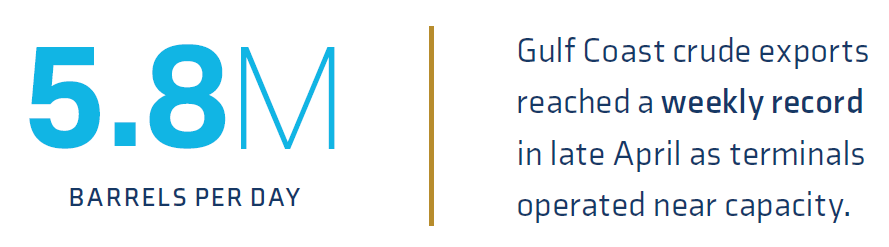
Since the conflict with Iran began in late February, disrupted flows through the Strait of Hormuz have sent global buyers to U.S. crude. Gulf Coast exports hit a weekly record of 5.8 million barrels a day in late April, with terminals running near capacity.16 The EIA expects Brent to average about $91 a barrel this year before easing as supply rebuilds, while U.S. output climbs to 14.3 million barrels a day in 2027.17 For midstream and terminal operators, months of running near capacity put more strain on aging assets; roughly half of U.S. oil and gas pipelines are more than 50 years old.18 Overseas, war-risk premiums for Gulf shipping peaked near 2.5% of hull value per week in March, against 0.1% to 0.15% before the conflict.19 Domestic marine remains soft, but war risk, sanctioned trades, and some marine liability lines are now behaving like specialty markets.
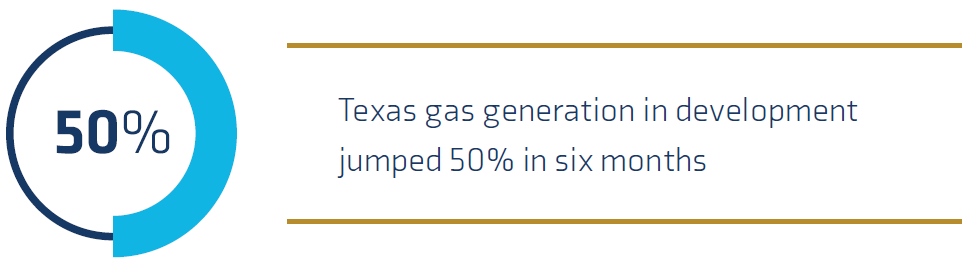
Data centers and manufacturing are pushing U.S. power generation to record highs, with natural gas supplying about 40%.20 In Texas, gas generation in development jumped 50% in six months, and the 12 largest planned projects are all meant to serve data centers.21 In August, the state paused new data center grid approvals pending an audit of projects representing 200 gigawatts of demand,22 pushing developers further toward behind-the-meter power.
Oilfield service companies are already taking on this work, running gas‑fired generator sets for data centers. That changes their exposure profile, adding power generation, fuel storage, and backup systems, each of which draws its own pollution and liability questions from underwriters.
PFAS, the “forever chemicals” in many firefighting foams, have become a long-tail liability for energy operators. In August, a federal appeals court upheld EPA’s designation of PFOA and PFOS, the two most common PFAS, as hazardous substances under the Superfund law.23 Superfund liability is strict and reaches back in time: a company can be responsible for cleanup even if it followed the rules when contamination occurred, and it can be held liable for the full cost even when others contributed. Refineries, terminals, tank farms, and gas plants have used this foam for decades, and PFAS can also turn up in produced water (the water that comes up with oil and gas) and process wastewater. Because most general liability policies exclude pollution, this exposure falls to PLL coverage. It also transfers with property, so PFAS belongs in the environmental review for any acquisition.
WHAT ENERGY OPERATORS NEED TO KNOW
U.S. upstream deal-making opened 2026 strong, then slowed sharply in the second quarter as oil price swings widened the gap between buyers and sellers. Analysts expect a second-half rebound.24 Permian acreage is trading at record prices, and asset-backed securitization buyers, private capital that funds producing assets, accounted for nearly 30% of deal flow.25 From an insurance standpoint, deals bring more than acreage. Risk control teams are seeing more losses tied to integration, driven by differences in operating procedures, equipment standards, casing designs, contractor practices, and safety management systems. Environmental liabilities transfer with the assets, and buyers adding older wells also inherit plug and abandonment (P&A) work, which the Q1 report identified as the leading source of well control risk.26 Operational, safety, and environmental due diligence costs far less before closing than after, and it should start before the deal is priced. For serial buyers, the goal is an insurance program built to absorb add-on acquisitions, not a patchwork of policies with mismatched renewal dates.
Operational, safety, and environmental due diligence costs far less before closing than after, and it should start before the deal is priced.
On many field sites, contractors now outnumber the operator’s own employees. That puts much of the highest-risk work, including high‑pressure operations, critical lifts, confined-space entry, and hot work, in the hands of people the operator didn’t hire or train. It’s also why risk control teams keeps finding contractor selection and oversight behind the industry’s most serious losses. With production rising and more crews and small independent contractors on location, the stakes are climbing.
When a contractor’s employee is hurt, the claim rarely stays in one place. With several layers of oversight on a site, fault is seldom clear. Injured workers are increasingly suing site operators, and operators push those claims back to the contractor through the indemnity terms in their service agreements. These action-over claims can hit auto, workers’ compensation, general liability, and umbrella from a single event, and both London and domestic underwriters are asking harder questions about them. Contract wording matters as much as the coverage. The Texas Oilfield Anti-Indemnity Act limits when one party can agree to cover another’s negligence on oilfield work. Operators working in states without a similar law that still choose Texas law in their contracts may take on those limits unintentionally, weakening the risk-sharing they thought they had.
The strongest programs treat contractor management as a discipline, not a checkbox. That means qualifying contractors before they arrive, observing high-risk work in the field instead of relying on paperwork, and tracking performance over time. Independent assessments that pair document review with field observation give operators an outside view and specific fixes, and partnerships with well control specialists add technical training and lessons from real incidents. On the contract side, review choice-of‑law and indemnity clauses before renewal, and understand the exposure that comes with hiring small contractors. Some clients are also adding arbitration terms to employment agreements to limit exposure to punitive damages, though arbitration can still produce large awards.
The strongest programs treat contractor
management as a discipline, not a checkbox.
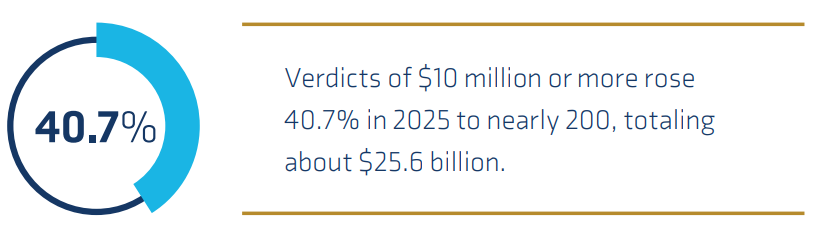
Large jury awards remain a major driver of casualty costs. Verdicts of $10 million or more rose 40.7% in 2025 to nearly 200, totaling about $25.6 billion, and 40 topped $100 million.27 Texas ranked among the top states, and oil and gas was among the industries most familiar with these awards.28 Third-party litigation funding is part of the story, and several energy-producing states, including Louisiana, Oklahoma, Kansas, and Colorado, have passed funding disclosure laws in the past two years.29 These trends shape where umbrella towers attach and how much limit is enough.
The Louisiana coastal lawsuits show how long and uncertain energy litigation can be. In 2025, a state jury ordered Chevron to pay about $745 million to restore wetlands in Plaquemines Parish. In April, the U.S. Supreme Court ruled 8-0 that the case belongs in federal court, putting the award in question and delaying any payout. The ruling could affect at least 11 of 42 coastal suits pending against oil and gas companies.30
Recent London energy loss reports are dominated by well control: blowouts, rig losses, and frac fires, including a cluster of Haynesville blowouts. Many trace back to the contractor oversight and operational gaps described above.
The smoothest claims start before the loss. Keep BI worksheets current, since disputes over values and indemnity periods are where BI claims most often stall. Put coverage instructions in writing, especially when adding newly acquired assets or asking to delay adding them, so there is a clear record if a loss follows. And review complex policies, including joint venture provisions and aggregate limits, for errors before a claim tests them.
The smoothest claims start before the loss.
Today’s soft market won’t last forever. Some underwriters are already hedging with longer policy terms, and warnings about casualty pricing are getting louder. This renewal cycle is a window worth using well. The clients who come out ahead will use it to strengthen their programs, not just to shave premium. When a claim hits, no one asks what the rate was; they ask whether the coverage was there. Before the next renewal, close coverage gaps, update limits and BI values, tighten fleet controls, and review contractor agreements. Those steps pay off at the renewal table and matter even more the day a loss arrives.
When a claim hits, no one asks what the rate was; they ask whether the coverage was there.
Stephanie Crochet |SVP, National Energy Practice Leader
Grady Goode | Senior Vice President, Energy Practice
Sharon Burger | Senior Vice President, Environmental Practice
Al Caceres | National Property Leader, Energy Practice
John Mizell | Director, Energy and Marine Practice
Mark Helmueller | Contractual Risk Attorney, Energy Practice
Donnie Steil | Risk Control Practice Leader, Energy Practice
Daniel Posnick | Liability Leader, Executive Risk Solutions
Angela Thompson | Marketing Strategist, Market Intelligence & Insights
Brian Spinner | Marketing Specialist, Market Intelligence & Insights