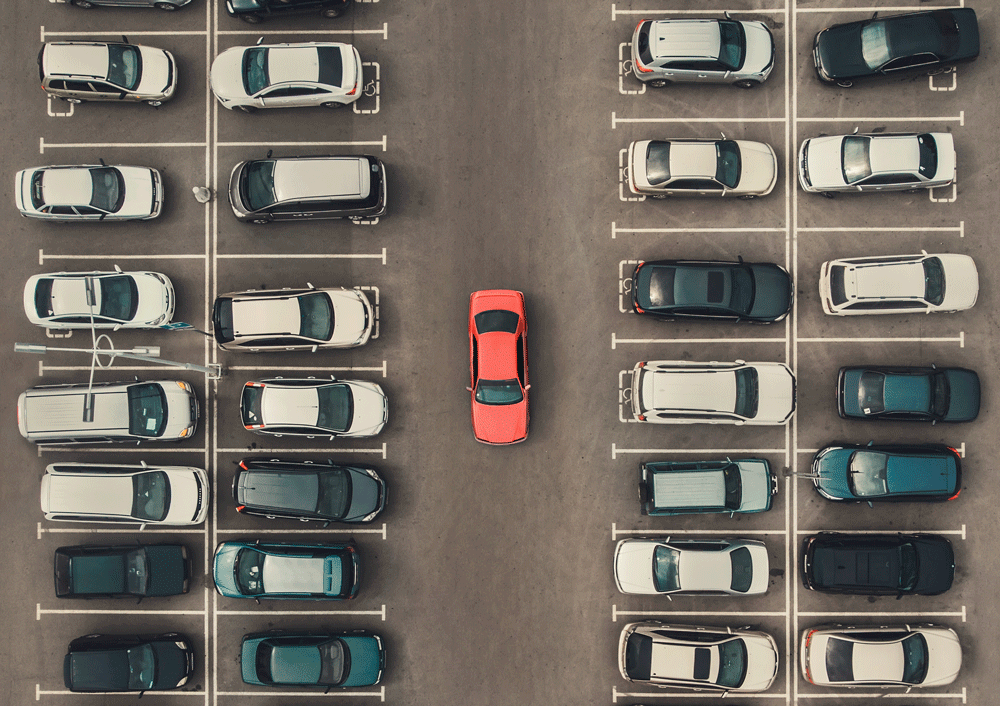
Preventing Vehicle Accidents in Restaurant Parking Lots Restaurant parking lots can be one of the highest-risk areas on the property due to the combination of vehicles, pedestrians, delivery drivers, employees, and guests. Common contributing factors include distracted driving, poor visibility, speeding, backing accidents, and unclear traffic flow.
Parking Lot Design & Maintenance
Clearly mark traffic lanes, stop signs, directional arrows, and pedestrian walkways.
Highlight changes in elevation for transitions up or down in areas that may cross into moving traffic.
Install pedestrian crossing signage to alert drivers.
Maintain parking lots free of potholes, debris, oil spills, and other hazards.
Ensure parking spaces are properly striped and visible.
Install speed bumps where appropriate to control vehicle speeds.
Use mirrors at blind corners and obstructed intersections, especially when pedestrians may cross into moving traffic or drive thru traffic.
Provide designated areas for delivery, rideshare, third party delivery and takeout pickup traffic.
Improve Visibility
Install and maintain adequate lighting throughout the parking lot.
Keep landscaping trimmed to eliminate blind spots.
Ensure signs, entrances, exits, and crosswalks are highly visible.
Use reflective paint and markings for speed bumps, curbs, and parking blocks.
Protect Pedestrians
Create clearly marked pedestrian walkways and crosswalks.
Provide safe routes from parking areas to restaurant entrances.
Encourage employees to use designated walkways when taking trash out or working outdoors.
Keep outdoor dining, waiting areas, and pickup locations separated from vehicle traffic.
Control Vehicle Speed
Post low speed limit signs (typically 5-10 mph).
Install speed humps or speed tables in high-traffic pedestrian areas.
Use traffic-calming measures near entrances and exits.
Monitor repeat speeding issues and address them promptly.
Employee Training
Train employees to:
Stay alert when walking through the parking lot.
Report suspicious vehicles or unsafe conditions.
Wear reflective vests when directing traffic or working outside.
Avoid distractions such as cell phones while walking or driving.
Use extreme caution when crossing drive-thru or order ahead lanes.
Delivery & Drive-Thru Safety
Separate delivery vehicles from customer parking when possible.
Establish designated pickup and loading zones.
Use cones, signage, or barriers where employees work near moving vehicles.
Ensure employees working outdoors can be easily seen by drivers.
Security & Monitoring
Install security cameras covering entrances, exits, and traffic areas.
Review and preserve video footage following incidents to perform a thorough investigation and identify trends and corrective actions.
Perform routine inspections of the parking lot and document findings.
Promptly repair damaged signs, lights, curbs, and pavement.
Top 10 Quick Actions Restaurant Managers can take today:
Post and enforce a 5-10 mph speed limit.
Stripe and repaint crosswalks.
Improve parking lot lighting.
Repair potholes and uneven pavement.
Trim shrubs and landscaping near drive lanes.
Highlight parking blocks and curb edges.
Add directional signage and traffic arrows.
Designate delivery and third party pickup areas.
Train employees on parking lot awareness.
Conduct monthly parking lot safety inspections.
Key Takeaway:
The parking lot is often the first and last impression guests have of your restaurant. By controlling vehicle speed, improving visibility, separating pedestrian traffic, and training employees on safe practices, restaurants can significantly reduce vehicle accidents, injuries, and liability exposures.
Preventing Vehicle-Into-Building Incidents at Restaurants
For restaurant and QSR locations, the best approach is to combine site design, physical barriers, traffic controls, and operating practices. The goal is to reduce the likelihood of a vehicle leaving the parking/drive-thru area and to protect areas where employees and guests are most exposed.
1. Install Physical Barriers
Consider protective barriers where vehicles are pointed directly toward the building.
Bollards near entrances, storefronts, patios, drive-thru windows, and pedestrian areas
Concrete or reinforced planters that provide separation between vehicles and the building
Guardrails or protective barriers where appropriate
Select barriers based on a qualified professional’s evaluation of vehicle speeds, approach angles, site layout, and required protection.
Avoid creating new pedestrian hazards or blocking accessible routes and emergency egress.
2. Reduce “Nose-In” Parking Toward Vulnerable Areas
Pay particular attention to parking spaces where a vehicle faces:
Glass storefronts or large windows
Main entrances and exits
Outdoor dining areas
Drive-thru windows
Employee workstations located against exterior walls
Where practical, consider reorienting parking spaces or adding protective separation between parking stalls and the building.
3. Provide Sufficient Separation
Create as much distance as practical between moving vehicles and the restaurant.
Examples include:
Raised curbs and landscaped islands
Sidewalks between parking stalls and the building
Landscaped buffer areas
Protective planters or barriers
Clearly separated pedestrian walkways
Important: A standard curb should not be relied upon as the sole protection against a vehicle entering a building.
4. Control Vehicle Speed
Lower parking-lot and drive-thru speeds reduce the opportunity for a high-energy impact.
Consider:
Clearly posted low-speed limits
Speed humps or other traffic-calming measures where appropriate
Directional arrows
Stop signs
High-visibility pavement markings
Well-defined drive aisles
5. Pay Special Attention to the Drive-Thru
QSR drive-thru lanes can place vehicles very close to the building.
Evaluate:
Tight turns and approach angles
Areas where vehicles face the restaurant
Drive-thru window protection
Pedestrian paths that cross the drive-thru
Curbs, islands, signs, and barriers that have already been struck
Delivery and trash collection areas that interactwith the drive-thru
6. Improve Pedestrian Protection
Vehicle intrusion prevention should also protect guests and employees outside the building.
Focus on:
Main entrances
Sidewalks
Outdoor patios
ADA-accessible routes
Employee entrances
Designated pickup areas
Curbside delivery spaces
Use high-visibility markings and physical separation where practical.
7. Inspect for Warning Signs
During routine exterior inspections, look for evidence that the property may have an elevated vehicle-strike exposure:
Damaged curbs
Bent signs or posts
Damaged bollards or planters
Tire marks over curbs or landscaped areas
Repeatedly damaged landscaping
Previous near misses or vehicle impacts
Confusing traffic patterns
Poor lighting or faded pavement markings
Repeated minor incidents can be an important signal that the site’s traffic pattern or protective measures need additional review.
8. Review the Site after Any Vehicle Incident
Even a minor parking-lot collision can provide useful information. Review:
What happened → where the vehicle traveled → why it left its intended path → who/what was exposed → what physical or operational change could reduce recurrence.
A simple question managers can use during a property walk:
“If a driver accidentally accelerates instead of braking, where could that vehicle go?”
Then look closely at anything in that path: entrances, windows, patio seating, employees, guests, drive-thru windows, and building walls.
Best Practices Following a Vehicle Incident in Your Parking Lot
For a restaurant parking lot, the response after a vehicle incident should focus first on people and scene safety, then documentation, notification, investigation, and corrective action. OSHA recommends investigating incidents to identify underlying hazards and corrective actions rather than simply assigning blame. OSHA Incident Investigation [osha.gov]
1. Protect People and Secure the Area
Check immediately for injuries.
Call 911 when emergency medical assistance, police, or fire response is needed.
Keep employees, guests, and bystanders away from moving vehicles, debris, leaking fluids, or damaged structures.
If a vehicle struck the building, canopy, utility equipment, bollards, or other structures, restrict access to the affected area until it is safe.
Do not put employees in danger trying to move a vehicle or debris. Protecting the health and safety of people at the site is the first priority after a serious incident.
2. Preserve The Scene
When it is safe to do so and without interfering with emergency responders:
Avoid moving vehicles or physical evidence unnecessarily.
Protect damaged property from additional contact.
Preserve relevant surveillance video before it is overwritten.
Identify witnesses and obtain contact information.
Preserving evidence and identifying witnesses can be important following a serious workplace incident. Reach out to the IMA Loss Prevention Team for assistance in the investigation or working with OSHA following the workplace incident.
3. Document The Incident
Take photographs or video showing:
Vehicle positions
Damage to vehicles
Damage to the building, signs, landscaping, light poles, bollards, curbs, etc.
Skid marks or tire tracks
Debris
Parking-space layout and traffic lanes
Pedestrian walkways/crosswalks
Lighting and visibility conditions
Weather or other relevant site conditions
Preserve the video surveillance before and after the incident.
Complete the company’s incident report using objective facts rather than assumptions about who was at fault. Guidance on post-incident documentation recommends focusing on who, what, when, and where and avoiding unsupported conclusions.
4. Gather Important Information
When appropriate, document:
Driver’s name and contact information
Vehicle description and license plate
Insurance information
Names/contact information for injured persons
Witness names/contact information
Police agency and report/case number
Date, time, and exact location
Employee(s) who responded
Description of property damage
For employees involved in an incident, follow the organization’s established workers’ compensation and injury-reporting procedures.
5. Notify The Appropriate Parties
Depending on severity and company procedures, promptly notify:
General manager/store manager
Risk Management/Risk Control
Insurance or Claims Advocate
Property/facilities management
Security
Building owner or landlord, when applicable
Instruct employees not to speak with the media regarding any events that occur in the workplace. Direct any media inquiries to the appropriate management contact or crisis management team.
Serious employee injuries may also trigger regulatory reporting requirements. Federal OSHA reporting requirements can apply to certain work-related fatalities and serious injuries. Refer to OSHA Reporting Requirements
6. Investigate The Cause
Once the immediate situation is controlled, look beyond the driver’s actions.
Consider:
Was traffic flow confusing?
Were parking spaces located too close to the building?
Were pedestrians and vehicles adequately separated?
Were signs or pavement markings missing or difficult to see?
Was lighting adequate?
Was landscaping blocking sightlines?
Did the layout encourage speeding or unsafe turns?
Would additional physical protection reduce the exposure?
OSHA specifically recommends looking beyond immediate causes and identifying underlying or root causes that can be corrected. OSHA Incident Investigation [osha.gov]
7. Take Corrective Action
Depending on what the investigation identifies, possible risk-control improvements could include:
Repairing damaged signs or pavement markings
Improving lighting or visibility
Adjusting traffic patterns
Improving pedestrian walkways
Adding or modifying parking lot striping
Removing sightline obstructions
Reviewing parking spaces facing entrances, dining areas, patios, or other occupied spaces
Ensure signage is in place showing height/width restrictions where applicable
Evaluating appropriately designed barriers or bollards where vehicle-to-building exposure warrants them
Risk Control Tip: The goal of the post-incident review should not just be “What did the driver do wrong?” It should also ask “What can we change about the property or operation to reduce the likelihood or severity of the next incident?”
OSHA Reporting Requirements
What Must Be Reported to OSHA Following a Workplace Incident?
All employers covered by OSHA must report the following work-related events, even if they are exempt from routinely maintaining OSHA injury and illness logs.
All work-related fatalities (Employee)
All work-related inpatient hospitalizations of one or more employees
All work-related amputations
All work-related losses of an eye
Reporting Timeframes
Event
Must Be Reported Within
Fatality
8 hours after learning of the death
Inpatient hospitalization
24 hours after learning of the hospitalization
Amputation
24 hours after learning of the amputation
Loss of an eye
24 hours after learning of the loss of an eye
Timing Limitations
A fatality is reportable only if it occurs within 30 days of the work-related incident.
A hospitalization, amputation, or loss of an eye is reportable only if it occurs within 24 hours of the work-related incident.
What Counts as An Inpatient Hospitalization?
OSHA defines inpatient hospitalization as a formal admission to the inpatient service of a hospital or clinic for care or treatment.
Not reportable:
Emergency Room or Urgent Care Clinic treatment only
Hospitalization solely for diagnostic testing or observation
Reportable:
Formal admission for treatment
Work-related heart attack resulting in hospitalization
Generally, reporting is not required when:
The event results from a motor vehicle accident on a public street or highway (unless it occurs in a construction work zone).
The event occurs on a commercial or public transportation system (airplane, train, bus, ferry, etc.).
The hospitalization is for diagnostic testing or observation only
 IMA Hospitality RRMA October 2026RRMA | October 2026
Oct 1, 2026
 Safety Best Practices for Employees Driving for Restaurant Business
Aug 5, 2026
 Best Practices for Maintaining Temperatures in Restaurant Walk-In Coolers & Freezers
Jul 22, 2026
 Proper Glove Usage in Restaurants
Jul 22, 2026