Real Estate
Markets In FocusMarket Update
Markets In Focus
Q3 2026
Real estate is experiencing two different insurance markets in Q3 2026. Property remains genuinely favorable, with carriers competing to match terms in order to keep good accounts. Capacity for most casualty lines remains tight and pricing elevated, with little indication of easing, especially for mixed-occupancy and habitational portfolios.
Underwriting flexibility is expanding, though much of it comes from carrier growth targets rather than a shift in how risk is viewed. If losses tick up, this trend could quickly reverse. Even as premiums come down, claims are taking longer to resolve and facing more scrutiny.
Two risks gaining notable attention are water damage, a persistent and costly loss driver, and lithium-ion battery and EV exposure. Proactive water detection technology is proving to be one of the most actionable investments property owners can make. Lithium-ion battery and EV exposure has eased in how underwriters approach it.
Addressing insurance needs for real estate calls for a clear-eyed read of where the market currently stands and a plan to use today’s favorable conditions to build proactive resilience before conditions shift again.
Property is favorable, casualty remains constrained, and claims are becoming harder to resolve.
Property coverage for real estate is currently in a buyer’s market. Commercial property premiums fell for the fourth consecutive quarter in Q2 2026, marking the largest premium decrease in 16 years.1 The softening in the property market comes from several factors, including a continued benign catastrophe environment and greater capacity, which is increasing competition.
Underwriting profitability improved industrywide last year, with commercial property loss ratios dropping to 85% at year-end 2025 from nearly 88% the year before.2 Reinsurance capital reached a record high heading into 2026, and catastrophe bond issuance set a new record. That capital is helping to fund the competition real estate clients are seeing at renewal, and carriers are being aggressive with quotes to keep accounts.
Rate is not always the biggest driver in this market. Wind and hail deductibles are down even when base rates are not moving much, which can lower the total cost of insurance more than only a rate cut might. Excess and surplus (E&S) lines pricing is still softening faster than the admitted market.
Still, that gap is narrowing as admitted carriers re-enter markets and lower their minimum value thresholds to compete for business they would not have touched a year ago. Florida’s Citizens Property Insurance Corporation has seen its policy count drop to an all-time low,3 as private carriers take on more of that risk, an indication of how much capacity has come back into the market broadly.
Catastrophe losses came in well below the long-term trend in 2025. Reinsurers have been clear this is favorable variability and not a sign that underlying risk has dropped. Estimates put 2026 first-half global losses at $42 billion, well below long-term trends, with severe convective storms remaining moderate in damages but elevated in occurrence.4
Casualty remains challenging for all industries, and real estate is no exception. Excess liability remains the most difficult line for real estate. General liability continued modest increases in Q2, and umbrella coverage rose more than any other casualty line of insurance.5 For real estate, high-limit capacity has become genuinely harder to find, not just more expensive. Lead umbrella layers of $5 million to $10 million are becoming standard, and carriers willing to put up $25 million or more in a single layer have grown scarce, pushing buyers who need higher limits toward layering multiple carriers and pulling in excess and surplus capacity to complete a tower.6
Mixed-occupancy portfolios feel this market the hardest. Real estate umbrella and purchasing group programs tend to exclude or restrict whatever piece of a portfolio appears riskiest to them, leaving owners with diverse occupancy properties to work harder to assemble a complete tower.
In habitational and affordable housing, carrier pricing remains tied to the perceived risk of the broader segment, with account-specific performance only going so far in offsetting concerns around loss severity and coverage exposure.
Carriers are reworking their reinsurance panels to offer higher assault and battery sublimits on smaller habitational deals, which have been difficult to place at adequate limits. It is not clear yet whether that capacity will hold up, but it is a trend worth watching.
The issue is no longer only price, it is the shrinking availability of meaningful high-limit capacity.
Retention is the mantra for carriers this year. In most lines, carriers are aggressively working to maintain good accounts. Carriers that would not have looked twice at certain deals a year or two ago are now considering what it will take to win or retain the business. In this market, the gap between incumbent renewal terms and new competitive alternatives can be significant, and incumbents may not fully recalibrate until they see credible risk of losing the account.
Actively shopping property renewals in the broader carrier market, rather than reupping with an existing carrier, is delivering real results. Companies may be tempted to treat a flat renewal as a win, given where the market has been.
Programs that would have been considered strong a year or two ago are quickly becoming the baseline expectation, and those who do not shop their renewal are likely leaving savings on the table.
The admitted market is actively pursuing business ceded to excess and surplus lines the past few years, particularly as the pricing gap between the two narrows. This shift is another advantage for property owners to work with at renewal.
Underwriting appetite is expanding; however, carriers are showing flexibility on risks to build their books, not as a reassessment of a risk. Some are adjusting underwriting guidelines to grow in certain segments. This does not reflect a durable change in how these risks are viewed, and the current flexibility could harden if losses occur. Clients benefiting from this relaxed underwriting should not assume the appetite is permanent.
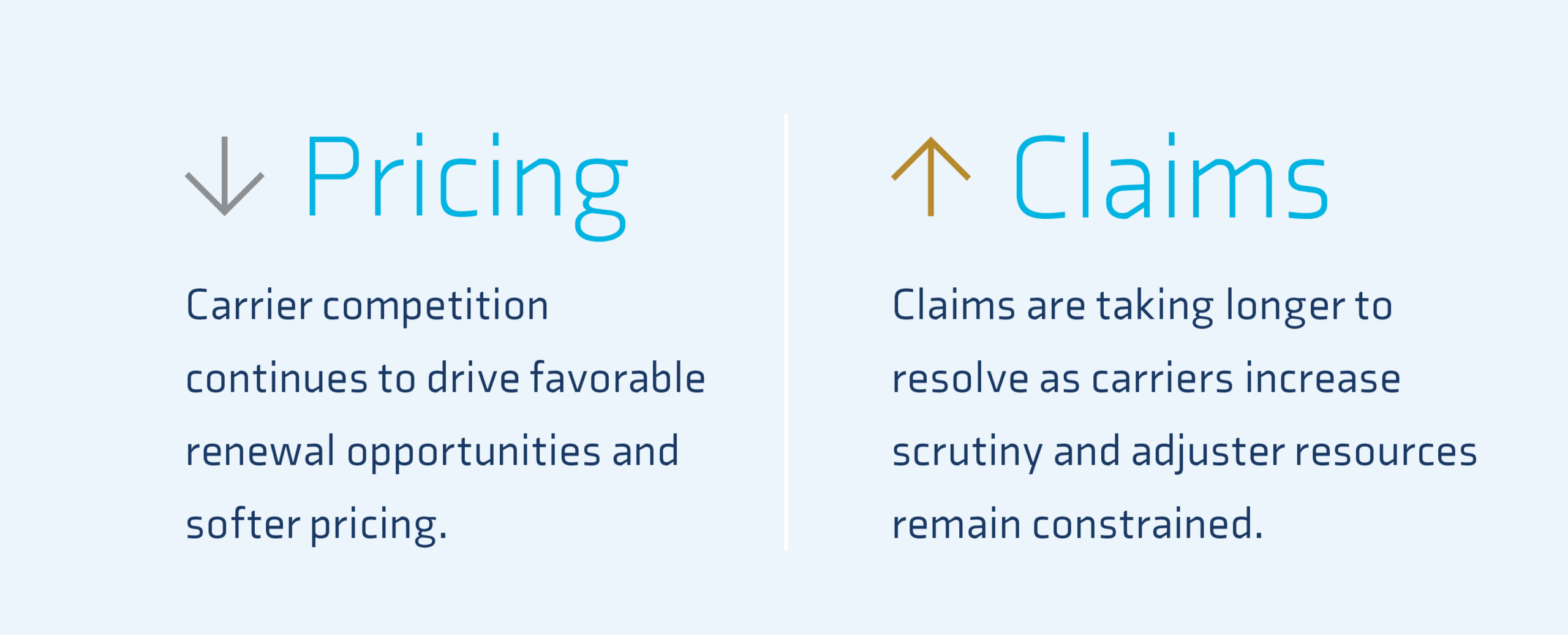
Claims friction is moving in the opposite direction from pricing. As premiums have come down, claims are taking longer to resolve, and carriers are scrutinizing policy language more closely than they were during the harder market. Clients should not expect softer pricing to come paired with softer claims handling. If anything, the two appear to be moving apart.
Capital is flowing back into real estate. Investment activity is expected to rise 16% in 2026, with AI-driven demand and reshoring fueling both industrial and office activity.7 Office is recovering unevenly, with prime vacancy tightening well below overall vacancy.8 Industrial demand remains strong on the back of reshoring and growth in third-party logistics, and retail continues to benefit from limited new supply, keeping availability tight.7 For owners and operators, this generally supportive backdrop is part of why carriers are competing harder for business: growing portfolios and stabilizing valuations make real estate a more attractive class to underwrite.
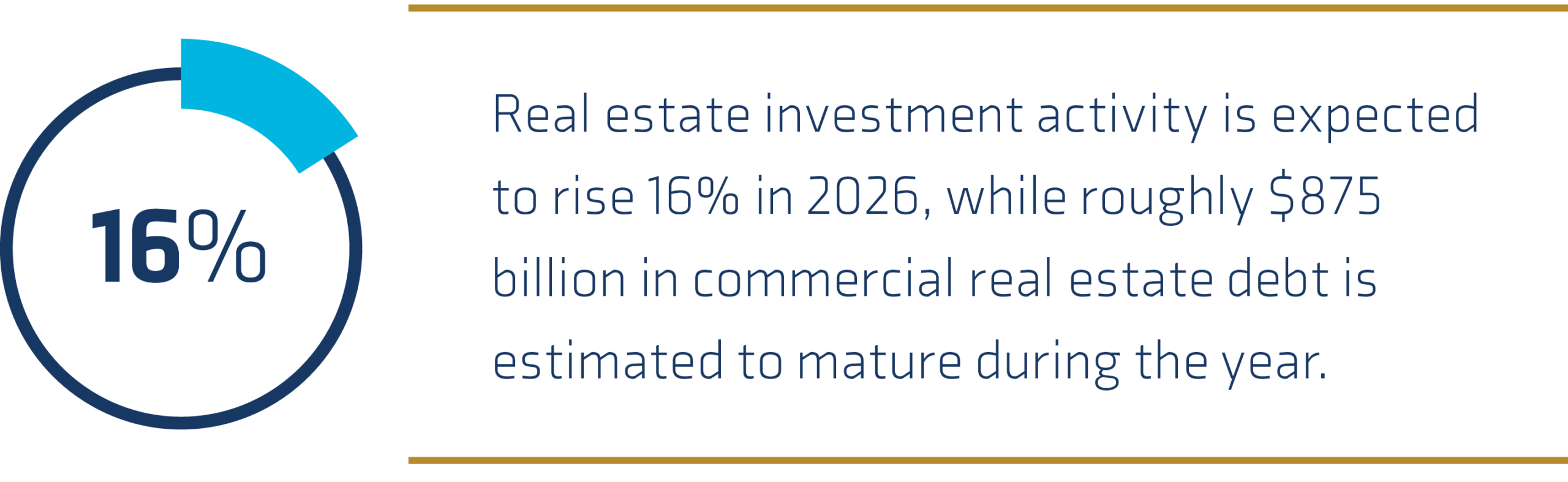
At the same time, a significant volume of commercial real estate debt is coming due this year. An often-cited estimate puts 2026 maturities at roughly $875 billion.9 Office, multifamily, and retail loans carry the most refinancing risk. This matters beyond financing conversations.
Owners under refinancing pressure are more likely to defer capital improvements, including risk-mitigation investments that carriers reward with better terms. That tension between capital discipline and risk investment is a worthwhile conversation during renewals.
Affordable housing continues to be underwritten with nuance. Carriers differentiate between Section 8 tenancy and Section 42 or LIHTC structures, and the distinction shapes which carriers compete for deals.
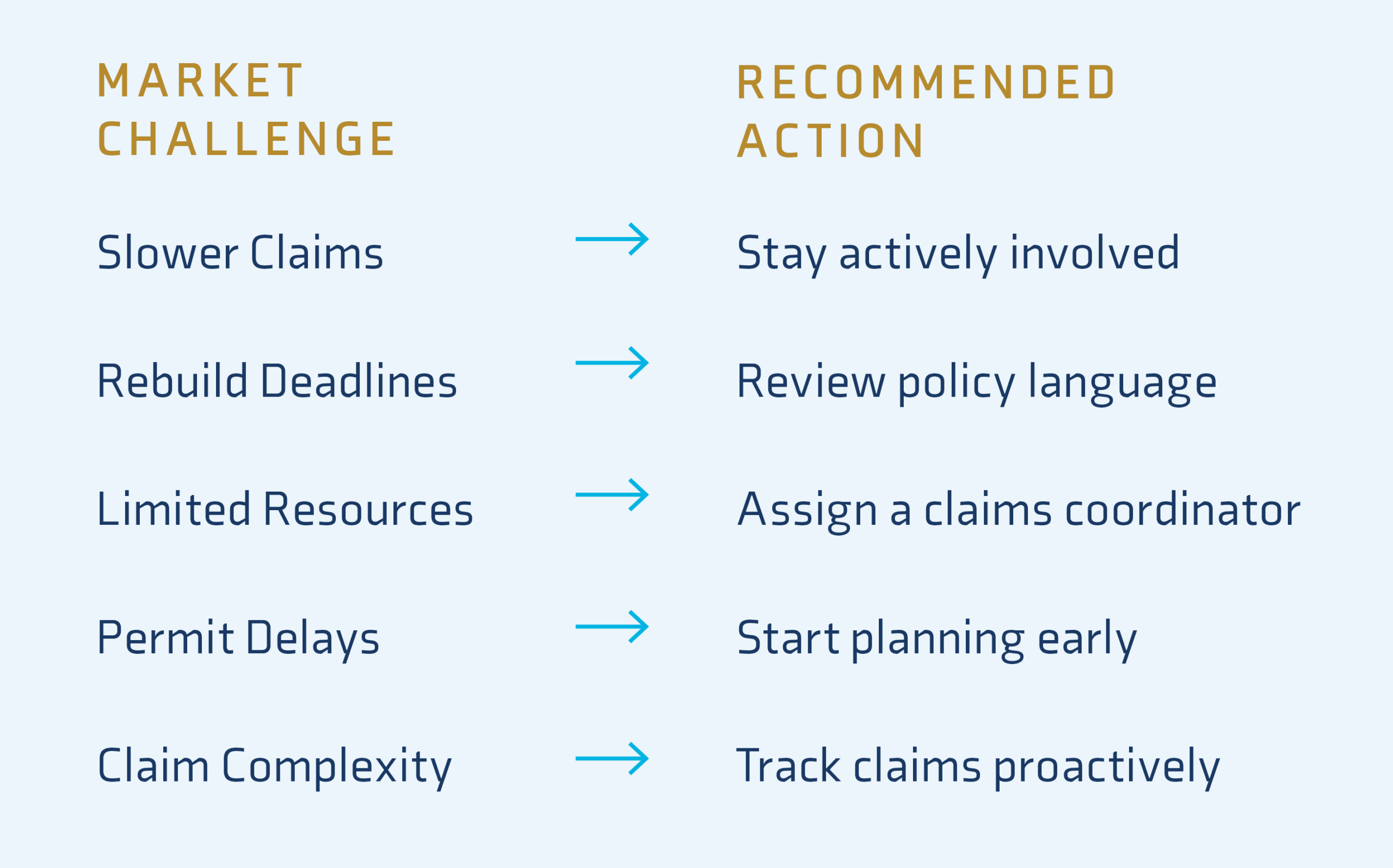
Claims are taking longer to close than they used to, and that slowdown is showing up across nearly every type of loss. Adjusters and third-party administrators are stretched thin industrywide. Some of this appears to be a byproduct of adjuster turnover and slow filling of vacancies.
Delays in claims and rebuilding can put coverage outcomes at risk.
Rebuild timing provisions are another growing source of friction. Many property policies include a two-year window to complete a rebuild before coverage terms change, often shifting a claim to actual cash value instead of full replacement cost if the deadline is missed. Delays in getting permits and plans approved put real pressure on deadlines. There is opportunity to build flexibility by proactively addressing contract language that treats a rebuild as compliant once the process has genuinely started, rather than requiring full completion by a deadline.
The clearest lever owners have to improve claims outcomes is engagement. A good practice is to designate an internal claims coordinator responsible for tracking a claim from notice through resolution. As claims handling continues to grow more restrictive and adjuster resources stay thin, that kind of proactive, engaged claims management is becoming less of a luxury and more of a vital part of real estate management.
Water is becoming the new fire risk. Water damage remains the most consistent and costly loss driver for real estate properties. It rarely makes headlines the way a fire or a windstorm does, but the damage accumulates one claim at a time; water is no longer a maintenance annoyance but a genuine underwriting priority.
Determining fault and coverage for water damage can be complicated, often leading to claim disputes. Water repairs can be costly, and carriers consider all aspects of the damage, from the source of origin to mitigation efforts. Carriers are looking at current and previous property owners and all recorded documentation. Owners who can produce a clean compliance history, inspection records, and permit documentation are in a far stronger position when a carrier tries to hold its line.
Installing water detection technology is an excellent opportunity for owners to show proactive mitigation. Inline flow-sensing systems paired with automatic shutoff valves should be installed in new construction and can be retrofitted into existing buildings. Real- world retrofit examples demonstrate the technology in use in older buildings. These systems typically do more than detect a burst pipe and usually pay for themselves in loss avoidance. Because these systems learn a building’s normal water usage pattern over time, they can flag abnormal flow, such as a fixture that has started running when it should not, well before it becomes a claim. From an insurance perspective, proactive water flow mitigation efforts are a critical long-term investment.
Lithium-ion battery risk has not gone away, but the tone has shifted. Just a year ago, underwriters were asking detailed questions about battery storage and charging infrastructure involving multifamily or mixed-use properties. That level of scrutiny has eased, in part because underwriters have more data on how thermal runaway occurs.
The remaining unresolved exposures are underground and enclosed parking. There is no strong industry answer yet for managing lithium-ion battery risk in below-grade garages. General liability exposure from off-gassing and ventilation during a battery fire event adds another layer of uncertainty. On the manufacturing side, sodium-based battery chemistry is being developed as a less reactive, lower-risk alternative to lithium, but that technology is not yet a practical mitigation option.
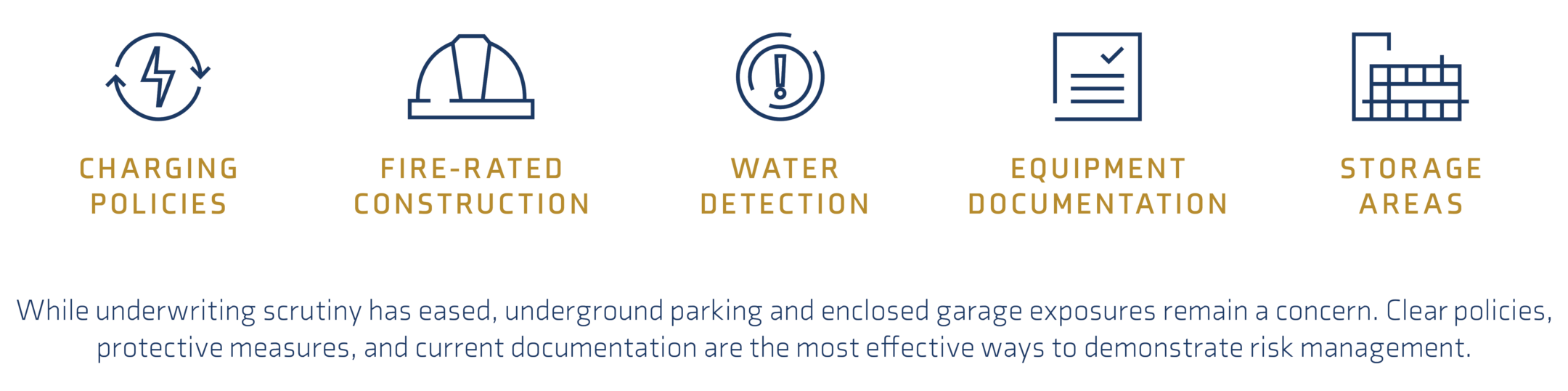
Until the underground parking exposure is better understood industrywide, the most effective steps available to owners are procedural rather than technological. That means clear policies on where charging is and is not permitted, protections such as fire-rated construction and water detection specifically in charging and storage areas, and keeping documentation current on any battery-related equipment on-site so it is ready if an underwriter asks. None of this eliminates the exposure, but it is what carriers can currently evaluate and reward with better terms.
The current real estate market rewards those who stay engaged with insurance considerations rather than complacent. Property remains favorable, but that relief is built on a calm 2025 catastrophe year more than a lasting change in risk. The climate could change quickly to a tighter market. Casualty remains challenging with no broad market softening in sight. Claims are taking longer and facing greater scrutiny even as premiums fall, making proactive claims management more valuable than ever. Those who reinvest insurance savings into risk mitigation, such as water detection technology, rather than treating premium relief as money saved, can use this window to strengthen their risk profile and be better positioned and better priced when the market inevitably turns.
Jim Litterer
EVP, National Real Estate Practice Director
Crystal Kohnert
SVP, National Accounts Director, Real Estate
Tracy Pride
EVP, Director of Client Services
Jennifer Barrat
SVP, Property and Casualty, Commercial Lines
Tyler Brevik
VP, Commercial Lines Leader
Erik Riddleberger
Director of Property, Risk Control
Amber Ryzner
VP, Real Estate
Tina Sparks
VP, Real Estate
Angela Thompson
Marketing Strategist, Market Intelligence & Insights
Brian Spinner
Marketing Specialist, Market Intelligence & Insights