Hospitality Markets In FocusMarket Update
Q3 2026
Hospitality operators are caught in a continuing cycle. Costs are rising and margins thinning. Once considered the cost of doing business, operators are beginning to scrutinize insurance costs line-by-line. Higher expenses squeeze margins already thinned by softer traffic and rising costs, forcing operators to consider less than ideal options including trimming services, cutting staff, and closing locations, or carrying less coverage. Those cuts often increase exposures, and unmanaged risks drive up the cost of insurance and narrows what carriers will cover.
The market itself is bifurcated. Property pricing is falling while casualty is challenging. Liability costs continue to climb and limits shrink, and a few lines are difficult to even place. The story for the second half of 2026 is straightforward: the operators who treat risk as a managed expense, with the documentation and training to prove mitigation efforts, are the ones breaking the cycle and earning better terms.
Hospitality operators who manage risk like an expense are the ones breaking the insurance cost cycle.
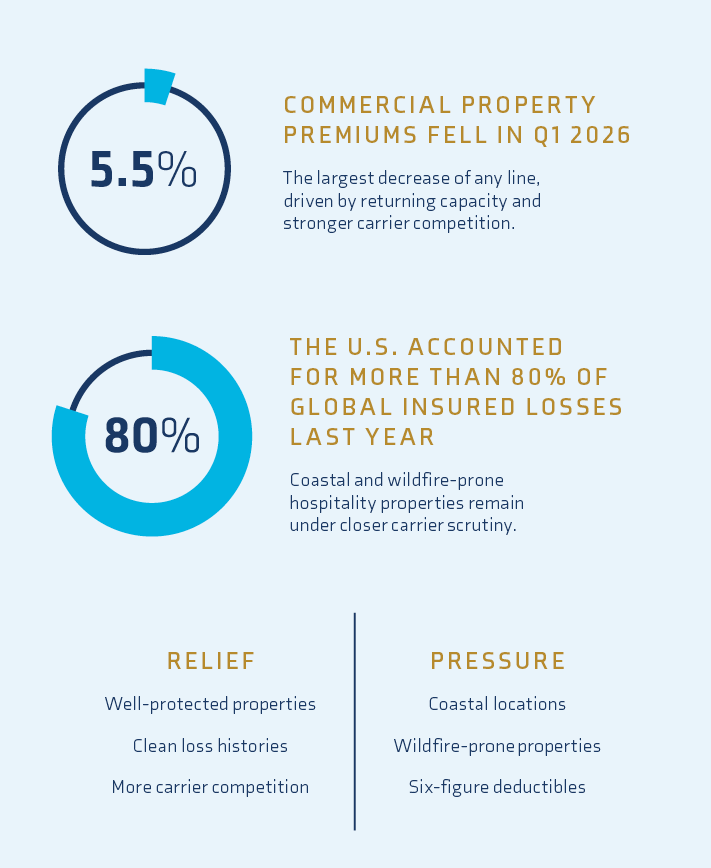
Property is the clearest bright spot. Commercial property premiums fell about 5.5% in the first quarter of 2026,1 the largest decrease of any line, as capacity returned and most respondents reported carriers competing harder for business. Well-protected hotels and restaurants with clean loss histories are seeing real relief.
Catastrophe-exposed properties still face high deductibles and placement challenges.
The headwind is catastrophe exposure. Coastal and wildfire-prone properties, especially economy hotels and specialty resorts, still face declinations, shared and layered placements, and minimum deductibles that can reach six figures. Carriers eased pricing even on some catastrophe-exposed risks, but that discipline may snap back quickly with a significant catastrophic weather event like a hurricane. 2025 saw the sixth consecutive year, global insured losses exceeded $100 billion (U.S. dollars), with the United States accounting for over 80% of these last year’s losses.2 Significant weather-related losses could test the softening fast.
Influenced by social inflation and nuclear verdicts, general liability (GL) and umbrella rates kept rising in early 2026 even as other lines softened. Increases are mainly hitting public facing industries3, such as hospitality, and the squeeze shows up in limits. Placing higher limits on a single layer is challenging, so programs are rebuilt into smaller towers, often with sexual abuse and molestation (SAM) exclusions attached. Moving from a $10 million to a $5 million limit may shave roughly 15% off the rate, which indicates the concerns carriers have with top end limits. While cyber pricing remains soft, a growing exposure for operators is the collection and saving of sensitive, personal information of guests and employees which is a growing area that threat actors target using social engineering.
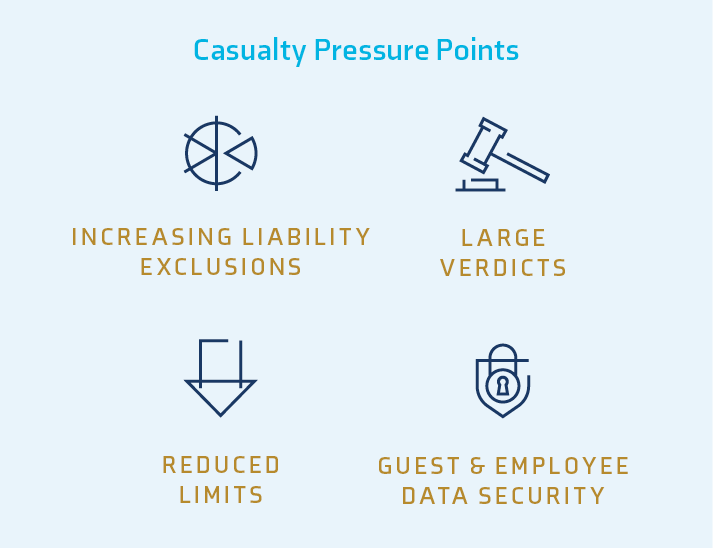
Several casualty lines continue to be challenging to place including: sexual abuse and molestation (SAM), liquor liability, and commercial auto.
SAM coverage has become a sticking point at renewal, especially for hotel properties with guest amenities. Carriers are scrutinizing anything that draws families and children, from arcades to spas, and they are getting granular. For example, with spa services underwriters now ask about the gender mix of massage staff and the training in place to prevent abuse. Carriers are growing concerned with human trafficking, with some markets outright excluding this coverage. Exposure can be considerable for owners and franchisors, and the current legal situation in determining fault is murky at best.
Simply put, placing liquor liability continues to be challenging. While carriers do consider the unique exposure by operations, for example when liquor revenue comes from a product’s cost rather than in high-volume, standard carriers are stepping back once alcohol passes 30% of a restaurant’s total revenue and pulling back from late night establishments. It’s not only restaurants or bars and clubs that carries are scrutinizing about alcohol, they are examining hotel properties whose operations includes on-premise liquor sales.
Auto is its own crisis. Commercial auto rose 5.8% in the first quarter, the highest increase of any line and its 59th straight quarterly rise.4 Restaurants offering delivery services are in a pinch, as the additional revenue is impacted by higher insurance rates. Operators with loses are realizing significant increases at renewal, some well past 200%. Operators are looking for outlets to offset costs and maintain revenue. Many are shifting delivery to third-party apps, which have their own costs, while others opt for non-owned auto coverage.
The push for new experiences and new revenue is reshaping the risk picture.
THC beverages are the trend for operators to enhance revenue. Cannabis-infused drinks are appearing on menus at bars and restaurants, sometimes without the operator telling their insurer. They can open a real coverage gap. Standard liquor liability responds to alcohol, not cannabis, and a claim tied to a THC drink can fall outside both general liability and liquor policies, since many forms exclude cannabis-based products. The exposure is unpredictable, especially when THC is mixed with alcohol, and there is not a long claims history for underwriters to price against. Operators who consider adding these drinks to their menu should consult with their broker.
Hospitality operators are also looking for an edge to attract customers, providing guests new experiences is always on trend. But extra amenities carry exposures an operation may not be ready for. If not fully vetted and managed, additional amenities meant to be guest perks, whether seasonal or permanent, can open risk-related scrutiny, particularly SAM exposure, and a stack of new policy requirements operators may not anticipate. Providing amenities is good business in meeting guest demand, but operators should fully understand the entirety of the costs across its operations and budget.
New revenue trends are reshaping hospitality risk — and not always within existing coverage.
The movement in private equity (PE) is firms buying up stressed properties and running them through third-party management companies. Yet, with an eye towards cost-savings, these operations tend to cut back on employee training and safety measures. This strategy runs contrary with mitigating exposures that carriers look for in keeping claims down and a key element for lower rates. When training and safety measures are reduced it perpetuates the cycle of higher incident rates that increase claims and premiums, which raises business expenses and impacts P&L margins. When the ownership changes hands, underwriters watch closely.
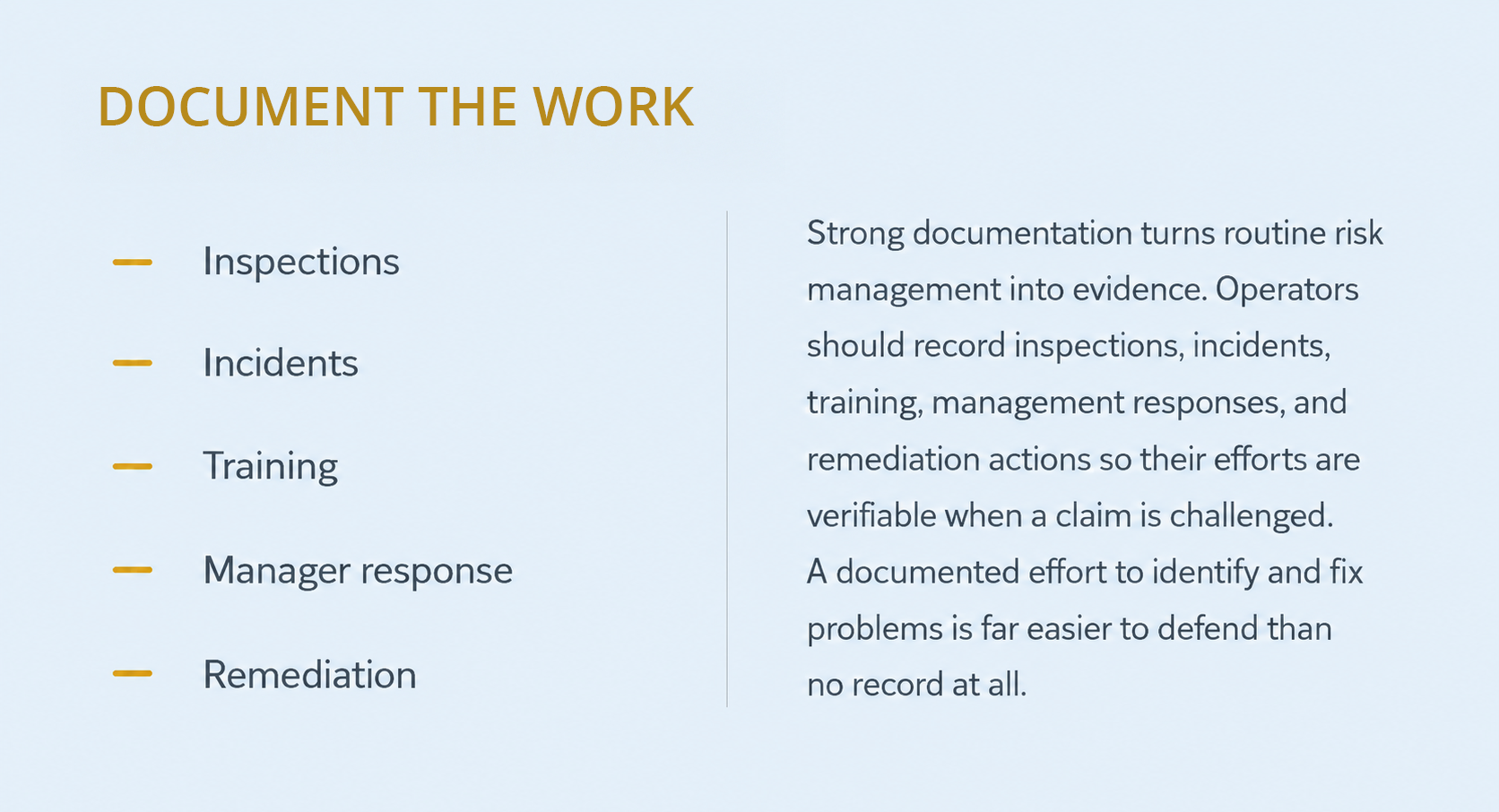
Across the industry, a quiet problem keeps surfacing. Operators do many things right yet fail to document much of their work. From inspections to incidents, the lack of documentation is a strike against the operator when a claim lands. Undocumented procedures are nearly impossible to defend, and unwitnessed losses turn into disputes that carriers settle rather than fight.
Harassment exemplifies this issue. Hospitality runs on a culture of friendliness and service, and that same culture can leave employees exposed to harassment from co-workers, managers, guests, and vendors. The cost of getting it wrong is steep. Settlements in hospitality harassment cases routinely reach six and seven figures, which a thin-margin business can rarely absorb.5
The fix is to make documentation a standard operating procedure. Adopt clear, written policies for every exposure and documentation procedures, whether the issue is harassment or parking lot safety. Train staff to report issues and managers on how to respond. Use available technology for documentation inspections, such as video, that can help provide claim defense. Many carriers provide programs and resources that operators can use that will help improve their documentation efforts, many which are included in their policies.
Some operators may resist documenting too much of their operations, concerned the records become discoverable. The better view is simple. A documented effort to find and fix problems is far easier to defend than no record.
Operators seek to provide entertainment amenities demanded by customers. Unfortunately, their drive to create more fun keeps colliding with more exposure, and carriers respond with tighter terms and higher rates. Nuclear verdicts, the term for jury awards above $10 million, are the force behind most of today’s claims pressure.
Many exposures seem obvious, such as adding a bar in a pool area. Some are not as obvious, such as unsecured beach umbrellas in a pool area that become projectiles in high winds. A shower seat is a considerate amenity for disabled persons but a liability if they collapse under guests during use. And front-desk key-card errors send guests into already-occupied rooms, leading to confrontations and injuries. Each points back to protocol: morning inspection routines, maintenance, and verification at check-in.
Slip-and-fall claims remain common and costly, often involving intoxicated guests, bathrooms, and losses no one witnessed, which makes them hard to investigate and harder to defend.
Inspect. Maintain. Verify.
Daily routines, regular maintenance checks, and front-desk verification can make the difference between a manageable incident and a costly claim.
On the regulatory side, California’s SB 68 will be one to keep an eye on. Effective starting July 1, 2026, the law requires restaurant chains with 20 or more locations to disclose major allergens on their menus, even if the business operates only one location in the state.6 This is the first law of its kind in the nation. Enforcement runs through state and local health agencies, but has no clearly defined civil penalty, which opens room for creative plaintiff theories and unsettled questions about which coverage, if any, would respond.
It may seem from an insurance perspective that the hospitality industry business environment is stuck in an ongoing loop. And for too many this story is true. But this cycle can be self-sustaining, or it can be broken. Left unmanaged, risk exposures eventually force carriers to raise rates and narrow coverage. This rising cost pressures revenue, which increases the temptation to cut vital operations or defer needed maintenance. These decisions actually fuel a new round of risks. The way out is to break the cycle on purpose. Treat insurance as a major expense, not just the cost of doing business, and focus on improving exposures, even in small increments. The operators who proactively address risks are the ones bending the cost curve instead of chasing it.
Tim Smith
EVP, National Hospitality Practice Director
Susan Devaughn
SVP, National Hospitality Program Director
Karie Bell
VP, National Accounts Restaurant Program Leader
Renee Rhodes
Hospitality Client Risk Advisor
Quinn Green
Risk Control Advisor
Joanna Birrell
SVP, Claims Leader
Walt Price
Claims Executive
Steve Garvy
Principal, The Garvy Group
Angela Thompson
Marketing Strategist, Market Intelligence & Insights
Brian Spinner
Marketing Specialist, Market Intelligence & Insights